
THE FIELD OF HOMOGENIZING
The field of homogenizing encompasses a very broad area. The
word homogenize means "to make or render homogeneous" while
homogeneous means "having the same composition, structure, or character
throughout". Homogenizing is what is called an umbrella word - a word which
covers a very large area. When someone says that they are homogenizing, they may
mean that they are actually doing one or more of the following, blending,
mixing, disrupting, emulsifying, dispersing, stirring etc. Therefore during this
writing when the word homogenizing is used it may mean any one or more of the
above mentioned processes.
The current processes or methods of homogenizing can be broken
down into three (3) major categories, ultrasonic, pressure, and mechanical.
ULTRASONIC HOMOGENIZING
One widely used method to disrupt cells is ultrasonic
disruption. These devices work by generating intense sonic pressure waves in a
liquid media. The pressure waves cause streaming in the liquid and, under the
right conditions, rapid formation of micro-bubbles which grow and coalesce until
they reach their resonant size, vibrate violently, and eventually collapse. This
phenomenon is called cavitation. The implosion of the vapor phase bubbles
generates a shock wave with sufficient energy to break covalent bonds. Shear
from the imploding cavitation bubbles as well as from eddying induced by the
vibrating sonic transducer disrupt cells.
There are several external variables which must be optimized to achieve
efficient cell disruption. These variables are as follows:
-
Tip amplitude and intensity
-
Temperature
-
Cell concentration
-
Pressure
-
Vessel capacity and shape
Modem ultrasonic processors use piezoelectric generators made
of lead zirconate titanate crystals. The vibrations are transmitted down a
titanium metal horn or probe tuned to make the processor unit resonate at 15-25
kHz. The rated power of ultrasonic processors vary from 10 to 375 Watts. low
power output does not necessarily mean that the cell disintegrator is less
powerful because lower power transducers are generally matched to probes having
smaller tips. It is the power density at the tip that counts. Higher output
power is required to maintain the desired amplitude and intensity under
conditions of increased load such as high viscosity or pressure. The larger the
horn, the more power is required to drive it and the larger the volume of sample
that can he processed. On the other hand, larger ultrasonic disintegrators
generate considerable heat during operation and will necessitate aggressive
external cooling of the sample. Typical maximum tip amplitudes are 30-250 urn
and resultant output intensities are in the range of 200-2000 W/square cm.
The temperature of the sample suspension should be as low as possible. In
addition to addressing the usual concerns about temperature lability of
proteins, low media temperatures promote high-intensity shock front propagation.
So ideally, the temperature of the ultrasonicated fluid should be kept just
above its freezing point. The ultrasonic disintegrator generates considerable
heat during processing and this complicates matters. Disruption can also be
enhanced by increased hydrostatic pressure (typically 15-60 psi) and increased
viscosity, providing the ultrasonic processor has sufficient power to overcome
the increased load demand and the associated sample heating problems can be
solved. For microorganisms the addition of glass beads in the 0.05 to 0.5mm size
range enhances cell disruption by focusing energy released by the bubble
implosions and by physical crushing. Beads are almost essential for disruption
of spores and yeast. A good ratio is one volume of beads to two volumes of
liquid. Tough tissues such as skin and muscle should be macerated first in a
blender or the like and confined to a small vessel during ultrasonic treatment.
The tip should not be placed so shallow in the vessel as to allow foaming.
Antifoaming agents or other materials which lower surface tension should be
avoided. Finally, one must keep in mind that free radicals are formed in
ultrasonic processes and that they are capable of reading with biological
material such as proteins, polysaccharides, or nucleic acids. Damage by
oxidatire free radicals can be minimized by including scavengers like cysteine,
dithiothreitol, or other SH compounds in the media or by saturating the sample
with a protective atmosphere of helium or hydrogen gas.
For practical reasons, the tip diameter of ultrasonic horns
cannot exceed about 3 inches. This sets a limit on the scale-up of these
devices. While standard sized ultrasonic disrupters have been adapted to
continuous operation by placing the probe tip in a chamber through which a
stream of cells flow, cooling and free radical release present problems.
PRESSURE HOMOGENIZING
High-pressure homogenizers have been used to disrupt
microbial cells for many years. With the exception of highly filamentous
microorganisms, the method has been found to be generally suitable for a variety
of bacteria, yeast and mycelia.
This type of homogenizer works by forcing cell suspensions
through a very narrow channel or orifice under pressure. Subsequently, and
depending on the type of high-pressure homogenizer, they may or may not impinge
at high velocity on a hard-impact ring or against another high-velocity stream
of cells coming from the opposite direction. Machines which include the
impingement design are more effective than those which do not. Disruption of the
cell wall occurs by a combination of the large pressure drop, highly focused
turbulent eddies, and strong shearing forces. The rate of cell disruption is
proportional to approximately the third power of the turbulent velocity of the
product flowing through the homogenizer channel, which in turn is directly
proportional to the applied pressure. Thus, the higher the pressure, the higher
the efficiency of disruption per pass through the machine. The operating
parameters which effect the efficiency of high-pressure homogenizers are as
follows:
-
Pressure
-
Temperature
-
Number of passes
-
Valve and impingement design
-
Flow rate
High-pressure homogenizers have long been the best
available means to mechanically disrupt nonfilamentous microorganisms on a
large scale. Animal tissue also can be processed but the tissue must be
pretreated with a blade blender, rotor-stator homogenizer, or paddle blender.
The supremacy of high-pressure homogenizers for disruption of microorganisms
is now being challenged by bead mill homogenizers. Still, in terms of
throughput, the largest industrial models of high-pressure homogenizers
outperform bead mills. The maximum volume of microbial suspension per hour
that can be treated by the larger commercial machines is 4,500 liters for
high-pressure homogenizers versus about 1,200 liters for bead mills. Even larger
capacity high-pressure homogenizers are available but their efficiency in
disrupting microbial cells has not been documented. This throughput advantage is
diminished somewhat by the fact that most high-pressure homogenizers require
several passes of the cell suspension to achieve high levels of cell disruption
whereas bead mills frequently need only one.
A familiar commercial high-pressure homogenizer for the
laboratory is the French press which uses a motor-driven piston inside a steel
cylinder to develop pressures up to 40,000 psi. Pressurized sample suspensions
up to 35m1 are bled through a needle valve at a rate of about 1 ml/min. Because
the process generates heat, the sample, piston and cylinder are usually
pre-cooled. Typical pressures used to disrupt yeast are 8,000 to 10,000 psi and
several passes through the press may be required for high efficiency of
disruption. Generally, the higher the pressure, the fewer the passes. Pressure
cells rated at 20,000 psi maximum come in capacities of 3.7 and 35m1 and there
is also a 35m1 capacity cell rated at 40,000 psi.
Most high-pressure homogenizers used for homogenization were
adapted from commercial equipment designed to produce emulsions and homogenates
in the food and pharmaceutical industries. They combine high pressure with an
impingement valve. Those with a maximum pressure rating of 10,000 psi rupture
about 40% of the cells on a single pass, 60% on the second pass, and 85% after
four passes. Capacities of continuous homogenizers vary from 55 to 4,500
liters/hr at 10-17% w/v cell concentrations. With the larger capacity machines
several passes are needed to achieve high yields of disruption. Considerable
heat can be generated during operation of these homogenizers and therefore a
heat exchanger attached to the outlet port is essential.
MECHANICAL HOMOGENIZERS
Mechanical homogenizers can be broken down into two (2) separate categories,
rotor-stator homogenizers and blade type homogenizers.
ROTOR-STATOR HOMOGENIZERS
Rotor-stator homogenizers (also called colloid mills or
Willems homogenizers) generally outperform cutting blade-type blenders and are
well suited for plant and animal tissue. Combined with glass beads, the
rotor-stator homogenizer has been successfully used to disrupt microorganisms.
However, the homogenized sample is contaminated with minute glass and stainless
steel particles and the abrasive wear to the rotor-stator homogenizer is
unacceptably high. Cell disruption with the rotor-stator homogenizer involves
hydraulic and mechanical shear as well as cavitation. Some people in the
homogenizing field also claim that there is to a lesser extent high-energy sonic
and ultrasonic pressure gradients involved.
I personally do not believe in the theory that high-energy
sonic and ultrasonic pressure gradients are involved with mechanical
homogenizers. The only thing that ultrasonic and mechanical (rotor-stator)
homogenizing have in common is that both methods generate and use to some
degree cavitation. Cavitation is defined as the formation and collapse of
low-pressure vapor cavities in a flowing liquid. Cavitation is generated as
you move a solid object through a liquid at a high rate of speed. In
ultrasonics the object being moved is the probe which is being vibrated at a
very high rate of speed generating cavitation. In mechanical homogenizing
(rotor-stator) the blade (rotor) is being moved through the liquid at a high
rate of speed generating cavitation.
The rotor-stator generator type homogenizer was first
developed to make dispersions and emulsions, and most biological tissues are
quickly and thoroughly homogenized with this apparatus. Appropriately sized
cellular material is drawn up into the apparatus by a rapidly rotating rotor
(blade) positioned within a static head or tube (stator) containing slots or
holes. There the material is centrifugally thrown
outward in a pump like fashion to exit through the slots or holes. Because the
rotor (blade) turns at a very high rpm, the tissue is rapidly reduced in size
by a combination of extreme turbulence, cavitation and scissor like mechanical
shearing occurring within the narrow gap between the rotor and the stator.
Since most rotor-stator homogenizers have an open configuration, the product
is repeatedly recirculated. The process is fast and depending on the toughness
of the tissue sample, desired results will usually be obtained in 15-120
seconds. For the recovery of intracellular organelles or receptor site
complexes, shorter times are used and the rotor speed is reduced. The
variables to be optimized for maximum efficiency are as follows:
-
Design and size of rotor-stator (generator)
-
Rotor tip speed
-
Initial size of sample
-
Viscosity of medium
-
Time of processing or flow rate
-
Volume of medium and concentration of sample
-
Shape of vessel and positioning of rotor-stator
The size of the rotor-stator probe (also called generator)
can vary from the diameter of a pencil for 0.01-10mI sample volumes to much
larger units having batch capacities up to 19,000 liters or, for on-line units,
capabilities of 68,000 liters/hr. Rotor speeds vary from 3,000 rpm
for large units to 8,000-60,000 rpm for the smaller units. In principle, the
rotor speed of the homogenizer should be doubled for each halving of the rotor
diameter. It is not the rpm's of the motor but the tip velocity of the rotor
that is the important operating parameter. Other factors such as rotor-stator
design, which there are many, materials used in construction, and ease of
leaning are also important factors to consider in selecting a rotor-stator
homogenizer.
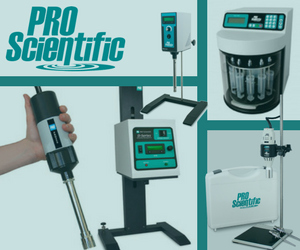
PRO Scientific's homogenizers have the
following tip speeds for the various rotor-stator generators:
Laboratory size rotor-stator homogenizers process liquid
samples in the 0.01 ml to 20 liter range. The capacity of the rotor-stator
should be matched to the viscosity and volume of the medium and with the type
and amount of plant and animal tissue to be processed. The speed and
efficiency of homogenization is greatly degraded by using too small a
homogenizer, and the volume range over which a given homogenizer rotor-stator
size will function efficiently is only about 10 fold. Also, most of the
laboratory-sized homogenizers function properly only with liquid samples in
the low to medium viscosity range (<10,000 cps). This must be balanced
against the practical observation that concentrated
samples, by colliding more frequently, are broken up more rapidly. Higher
viscosity samples can be processed but require specially shaped homogenization
vessels or unique rotor-stator configurations. The size of the sample prior to
processing with the homogenizer must be small enough to be drawn inside the
stator. Therefore, samples often must be pre-chopped, cut or fragmented.
Foaming and aerosols can be a problem with rotor-stator
homogenizers. Keeping the tip of the homogenizer well submerged within the media
and the use of properly sized vessels helps with the first problem.
Square-shaped or fluted vessels give better results than round vessels and it is
also beneficial to hold the immersed tip off center. Aerosols can be minimized
by using covered vessels. Pro Scientific offers a complete line of Safety Sealed
chambers which eliminate the aerosoling problem. The most widely used Safety
Sealed chambers are those of the ST series. The ST series uses four different
size standard laboratory test tubes and incases them within a sealed cage. The
four units currently in the ST series are as follows:
There are no aerosols with in-line homogenizers. Even
though a number of the laboratory rotor-stator homogenizers use sealed motors,
none of them are truly explosion-proof. Due caution should be followed when
using flammable organic solvents by conducting the homogenization in a well
ventilated hood. On the positive side, rotor-stator homogenizers generate
minimal heat during operation and this can be easily dissipated by cooling the
homogenization vessel in ice water during processing.
The larger rotor-stator homogenizers are either scaled up
versions of the laboratory models or in-line homogenizers. The latter contain
teeth on the edge of a horizontally oriented, multi-bladed, high-speed
impeller aligned in close tolerance to matching teeth in a static liner.
BLADE TYPE HOMOGENIZERS
Although less efficient than rotor-stator homogenizers, blade
homogenizers (also called blenders) have been used for many years to produce
fine brie and extracts from plant and animal tissue. The cutting blades on this
class of homogenizer are either bottom or top driven and rotate at speeds of
6,000 to 50,000 rpm. Blenders are not suitable for disruption of microorganisms
unless glass beads or other abrasives are added to the media and then one
encounters the same problems as were mentioned above for rotor-stator
homogenizers. Many plant tissue homogenizers undergo enzymatic browning which is
a biochemical oxidation process which can complicate subsequent separation
procedures. Enzymatic browning is minimized by carrying out the extraction in
the absence of oxygen or in the presence of thiol compounds such as
mercaptoethanol. Sometimes addition of polyethylene imine, metal chelators, or
detergents such as Triton X-100 or Tween-80 also helps.
Blade homogenizers are available for a range of liquid sample
sizes from 0.01 ml to multi gallons. Some of the higher rpm homogenizers can
reduce tissue samples to a consistent particulate size with distributions as
small as 4um as determined by flow cytometric analysis. Accessories for some
blenders include cooling jackets to control temperature and closed containers to
minimize aerosol formation and entrainment of air. PRO Scientific has a complete
line of Safety Sealed chambers which eliminates the aerosoling problem as well
as the problem of introducing air into the sample.
See Also:Wikipedia Homogenize
by
Richard M. Yacko
President
PRO Scientific Inc.
|